Introduction
You open a message that just says "ts pmo" and stare at it for a second too long. So what does TS mean in text, exactly? The honest answer is: it depends. Those two little letters have quietly become one of the most flexible abbreviations online, shifting meaning from one app to the next and from one generation to another. On TikTok it might mean one thing, in a work chat another, and in an old group thread something else entirely. This guide breaks down every common meaning of TS, shows you how to read the context, and explains how to handle it when slang lands somewhere it does not belong. Let us decode it.
- What TS most often means in texting today
- Every common meaning, from this stuff to timestamp
- How to decode the viral "ts pmo" combo
- Why texting shorthand like TS spreads so fast
- How context — app, words, tone — decides the meaning
- How to reply to a TS text, in chat and at work
So, What Does TS Mean in Text?
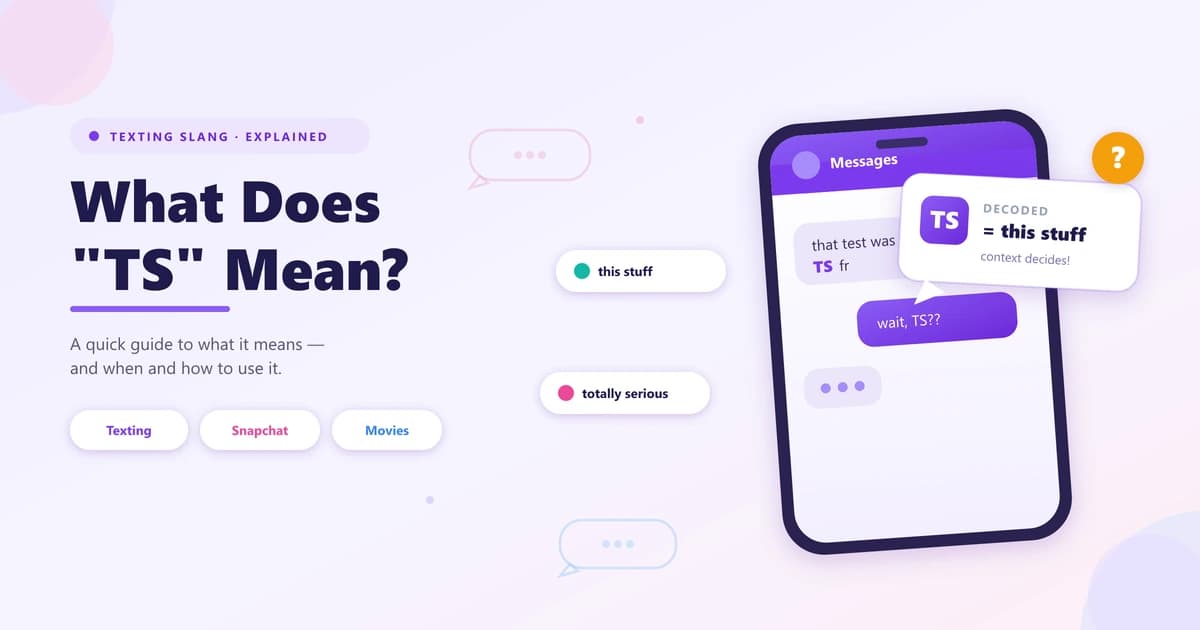
Most often in 2026, TS is shorthand for "this" paired with a mild swear, used to vent. Think of it as a punchy way to say "this stuff" when something is annoying. That is the meaning driving its current popularity, especially among Gen Z.
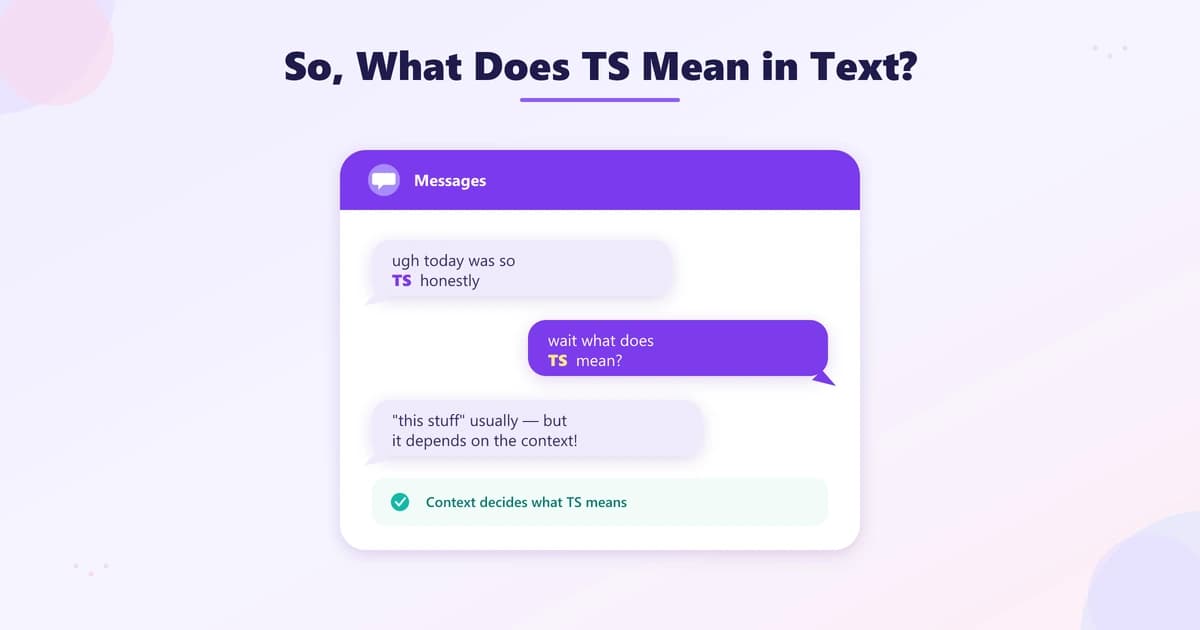
But TS is a true chameleon. The same two letters can mean "tough luck," "talk soon," "true story," "too soon," or even a plain "timestamp," depending entirely on who is typing and where. None of these are wrong; they simply belong to different corners of the internet.
So when you wonder what TS means in a text message, the real question is always context. Hold that thought, because the rest of this guide is essentially a map for narrowing it down.
Every Common Meaning of TS, Decoded
Here are the meanings you are most likely to run into, with the vibe behind each.
Picture the same two letters in three messages. "ts pmo fr" from a teenager is venting. "ts, gotta run" from a coworker is a friendly sign-off. "jump to ts 4:12" in a video comment is a timestamp. Identical letters, three unrelated meanings, all decided entirely by the words, the app, and the setting around them. That is exactly why a single fixed definition will never cover TS on its own.
- **"This" + a swear (this stuff):** the dominant slang use today, to express irritation
- **Tough luck:** a blunt, dismissive reply to a complaint
- **Talk soon:** an older, friendly sign-off from early chat rooms
- **True story:** a way to confirm something really happened
- **Too soon:** when a joke lands before people are ready for it
- **Timestamp:** a neutral, technical meaning in apps and videos
TS PMO: Breaking Down the Viral Combo
A lot of the recent confusion comes from one pairing: "ts pmo." This combo went viral and pushed TS back into the spotlight.
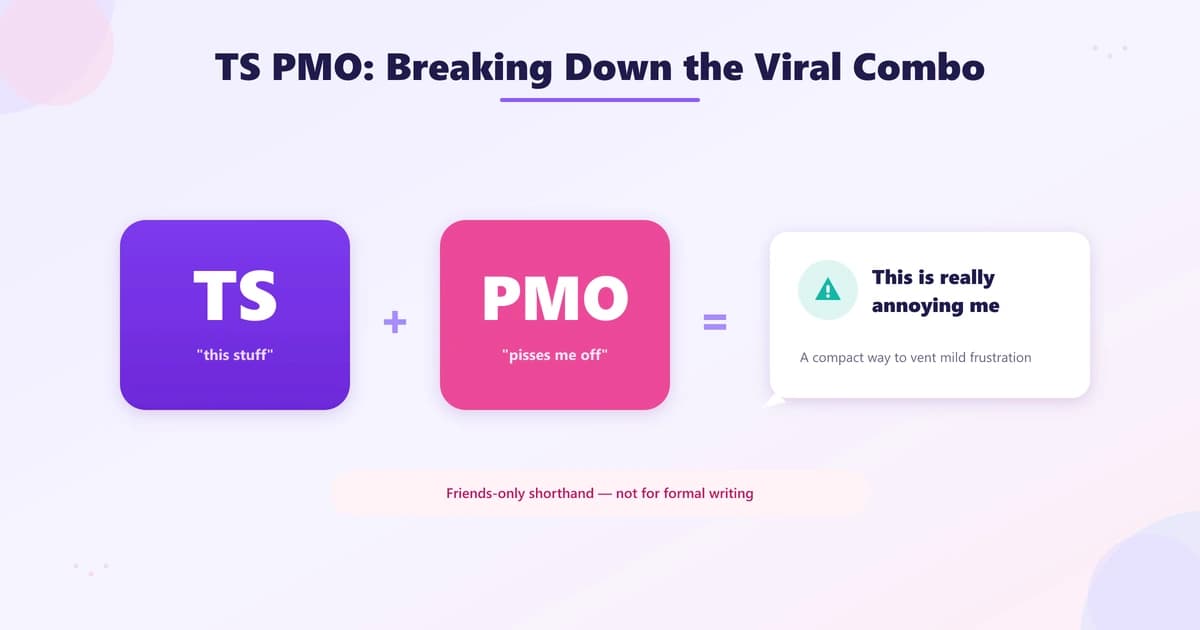
Broken down, TS stands for "this stuff" and PMO usually means "pisses me off." Strung together, "ts pmo" is a compact way to say "this is really getting on my nerves." It is a reaction, not a conversation starter, and it signals mild frustration rather than full-blown anger.
You will sometimes see it stretched further, as in "ts pmo icl," where ICL adds "I can't lie." None of these belong in formal writing; they live in fast, casual, friends-only exchanges.
A quick example shows how it works. If a friend texts, "ts pmo, my bus is late again," they are not furious; they are mildly griping about a recurring annoyance. A fitting reply might be, "ugh, same every morning." The phrase is built for low-stakes venting between people who already speak the same shorthand.
Why TS Took Off: The Rise of Texting Shorthand
TS did not appear overnight. It rode the same wave that gave us BRB, LOL, and TBH: the constant pressure to type faster on small screens. Every era of online chat has invented abbreviations, and short, punchy ones spread the fastest.
Two forces pushed TS into heavy rotation. First, character-limited and fast-scrolling platforms reward brevity, so two letters beat a full phrase. Second, slang signals belonging. Using TS the "right" way marks you as fluent in a particular online community, which is part of why younger users adopt it so eagerly.
That is also why the meaning keeps drifting. An abbreviation that means "talk soon" to one group can be repurposed as "this stuff" by another, and both versions survive side by side. Texting shorthand is less a fixed dictionary than a living, regional dialect that changes with the app and the audience.
TS at Work: When Slang Meets Business Messaging
Here is where it gets practical. As texting becomes a core channel for customer support, sales, and appointment reminders, slang like TS can quietly create problems. A customer who texts "ts pmo" to a support line is expressing frustration, and missing that cue means missing the moment to help.
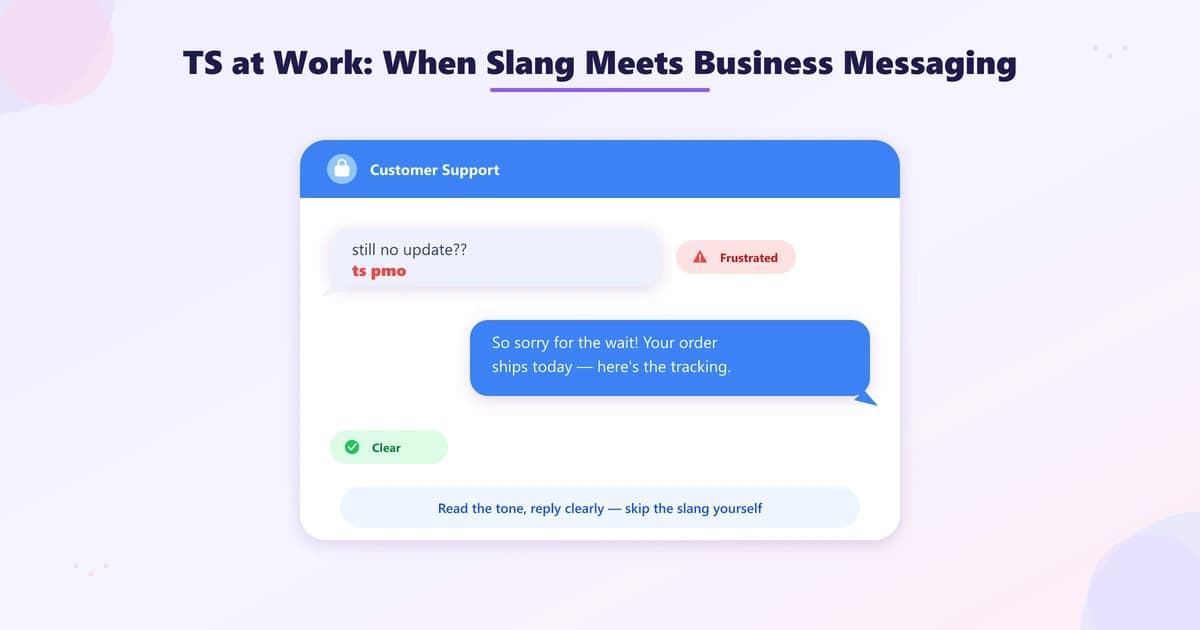
For a business, the goal is clarity in both directions. Your outgoing messages should never rely on ambiguous shorthand, and your team should be able to interpret incoming slang so tone is not lost. A platform like Teloz, which has shaped business communication tools since 2005, helps teams manage business texting and customer conversations in one organized place, so a frustrated "ts pmo" gets a fast, human response instead of a confused one.
The lesson is not to ban slang. It is to know your audience: playful with friends, plain and professional with customers.
Reading the Room: How Context Decides the Meaning
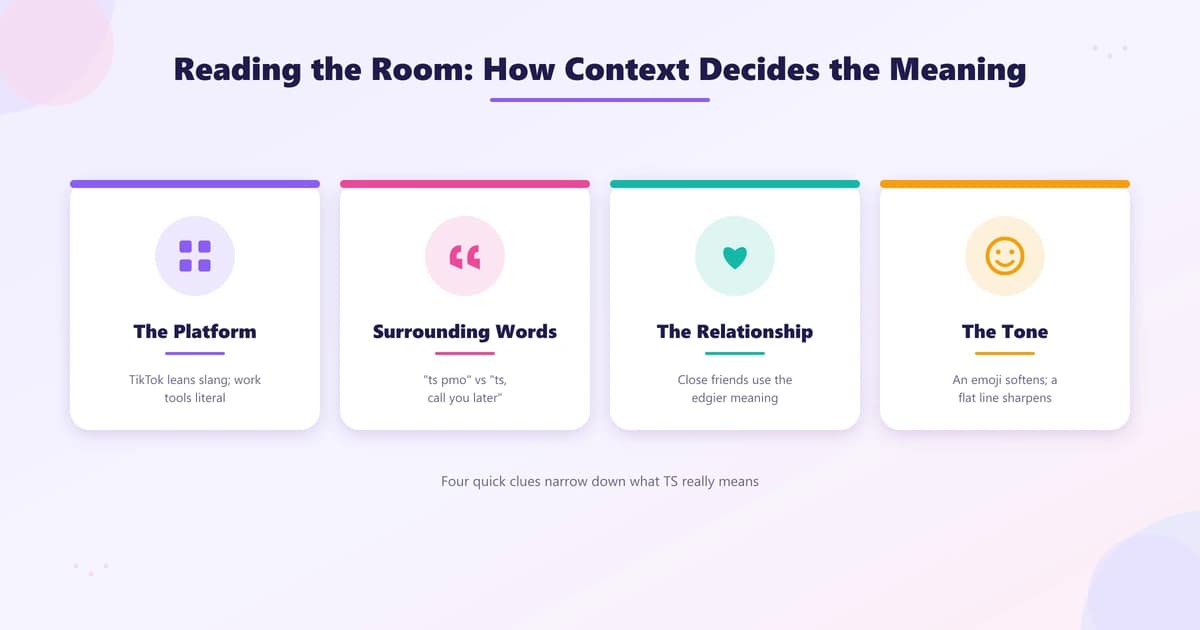
Since TS shifts so much, a few context clues do most of the work.
Slang evolves faster than any rulebook, which is why even mainstream references like the Merriam-Webster dictionary now track how internet abbreviations shift over time. When you are unsure, it is perfectly fine to simply ask, "what do you mean by ts?" Clarifying is far better than guessing wrong.
- **The platform:** TikTok and Snapchat lean slang; work tools lean literal
- **The surrounding words:** "ts pmo" reads as frustration; "ts, I'll call you later" reads as talk soon
- **The relationship:** close friends use the edgier meanings
- **The tone:** a laughing emoji softens it; a flat sentence sharpens it
“TS is not one slang term but a small family of them — context, not the letters, decides which one you are reading.”
Replying to a TS Text Without Missing a Beat
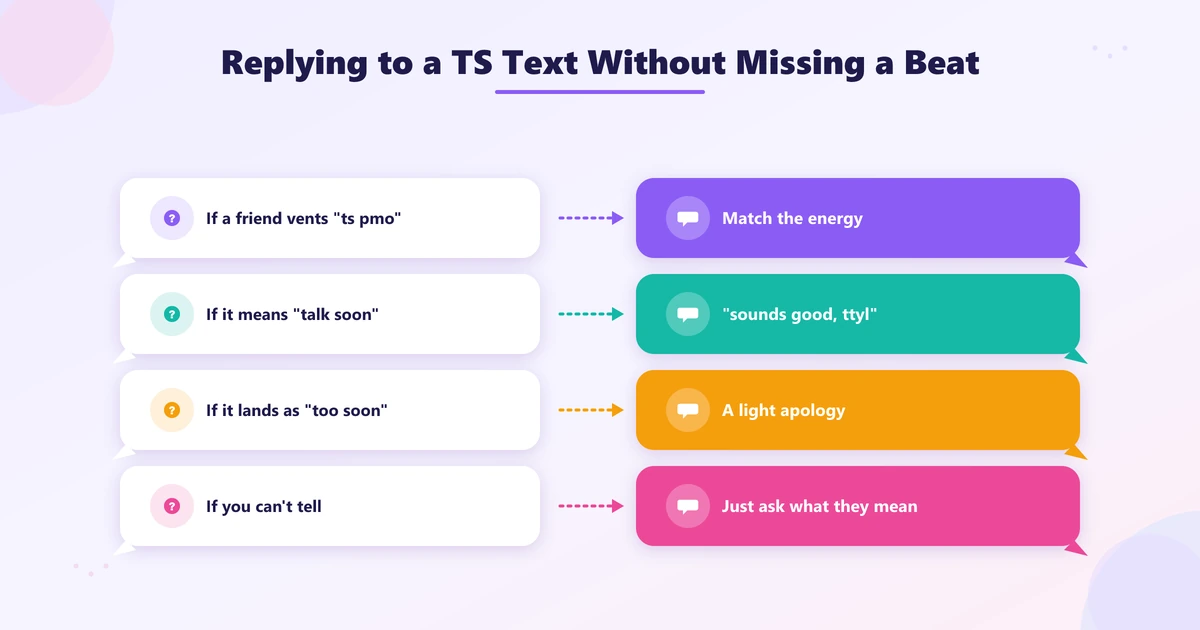
Once you have decoded the meaning, your reply should match the register of the conversation. A few quick guidelines help.
In professional settings the rule flips. Keep your own replies clear and slang-free, and let tools that organize your cloud-based business conversations help you respond quickly and consistently. Speed plus clarity is what turns a confused exchange into a satisfied customer.
- If a friend vents with "ts pmo," meet the energy and acknowledge the frustration
- If it means "talk soon," a simple "sounds good, ttyl" closes the loop
- If it is "too soon," a light apology keeps things friendly
- If you genuinely cannot tell, ask before assuming
Conclusion
So, what does TS mean in text? Most of the time today it is a quick, slightly salty way to say "this stuff," especially in "ts pmo," but it can just as easily mean "talk soon," "true story," "too soon," or "timestamp." The single rule that never fails is to read the context: the app, the words around it, and your relationship with the sender. That same instinct matters in business, where clear messaging beats clever shorthand every time. If your team handles customer texts and wants tone and speed in one place, see how Teloz approaches modern business communication at teloz.com.